Funding arb strategy limits to account for
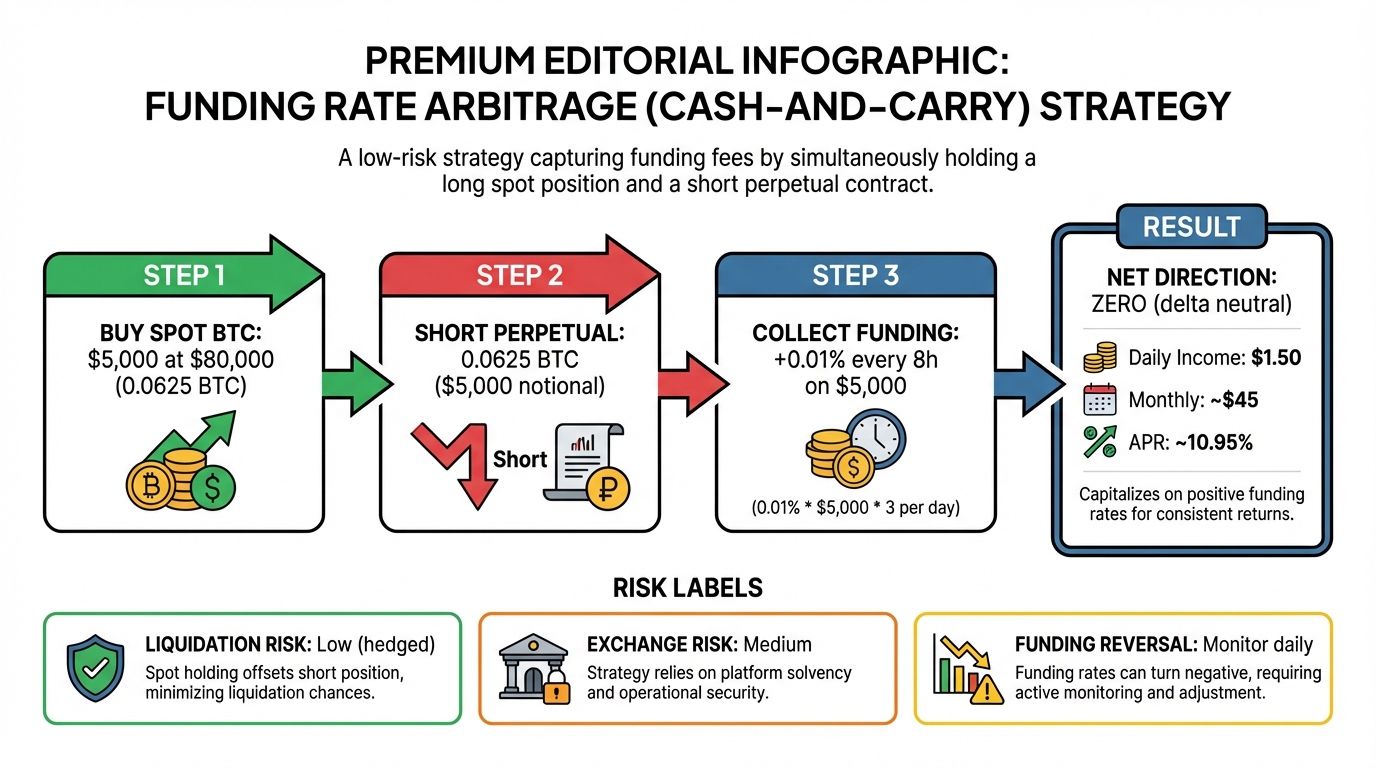
Funding rate arbitrage captures the spread between spot and perpetual futures prices. You open offsetting positions—long spot, short futures—to collect funding payments when the market is in contango. The goal is to isolate the funding yield while neutralizing directional price risk.
This strategy is not risk-free. The primary constraint is basis risk: if the funding rate turns negative, your short futures position pays the long spot position, eroding your yield. You must monitor rates daily to avoid paying into a downtrend.
Liquidity and execution costs are the other major hurdles. Slippage on entry and exit, plus exchange fees, can eat into thin margins. A strategy that looks profitable on paper may fail in practice if the spread doesn't cover transaction costs. Always calculate the net yield after all fees before deploying capital.
Funding arb strategy choices that change the plan
Funding rate arbitrage collects payments from the crypto futures market without taking directional price risk. The strategy relies on the price difference between perpetual swaps and spot markets. However, the "risk-free" label often masks concrete operational hurdles and hidden costs that can erode returns.
Before committing capital, you must evaluate three primary tradeoffs: exchange counterparty risk, liquidation vulnerability during extreme volatility, and the impact of fees on net yield. While the concept is straightforward—going long spot and short perpetuals—the execution requires precision.
Core choices that change the plan
- Exchange Risk: Your spot holdings and short positions are held on different platforms. If one exchange halts withdrawals or faces insolvency, your hedge breaks. This is the single largest structural risk in the strategy.
- Liquidation Risk: Perpetual futures are leveraged instruments. A sudden market crash can trigger liquidation on your short leg, leaving you with a long spot position and no hedge. You must monitor margin ratios closely.
- Fee Drag: Trading fees, funding payments, and withdrawal costs eat into profits. In low-funding environments, these costs can turn a positive carry into a net loss.
| Feature | Perpetual Arb | Basis Trade | Cash & Carry |
|---|---|---|---|
| Market Risk | Low | Low | Low |
| Complexity | Medium | High | Low |
| Liquidity Needs | High | Medium | Low |
| Capital Efficiency | High | Medium | Low |
Choosing the Right Approach
Your choice depends on capital size, technical capability, and risk tolerance. Perpetual arbitrage is accessible to retail traders due to high liquidity and ease of entry. Basis trades require more sophisticated infrastructure to manage expiry dates and roll costs. Cash and carry strategies are best for larger institutions seeking steady, low-volatility yields.
Always backtest your strategy against historical funding rate data. Use tools like Amberdata or Kraken’s research to understand regime changes. Remember that past performance does not guarantee future results, especially in a market as volatile as crypto.
Choose the next step
Funding Arb Strategy works best as a clear sequence: define the constraint, compare the realistic options, test the tradeoff, and choose the path with the fewest hidden costs. That order keeps the advice usable instead of decorative. After each step, pause long enough to check whether the recommendation still fits the reader's actual situation. If it depends on perfect timing, unusual access, or a best-case budget, include a simpler fallback.

Avoid the weak options
Use this section to make the Funding Arb Strategy decision easier to compare in real life, not just on paper. Start with the reader's actual constraint, then separate must-have requirements from details that are merely nice to have. A practical choice should survive normal use, maintenance, timing, and budget. If a recommendation only works in an ideal situation, call that out plainly and give the reader a fallback path.
The simplest way to use this section is to write down the must-have criteria first, then compare each option against those criteria before weighing nice-to-have features.
Funding arb strategy: what to check next
Helpful gear
Use these product recommendations as a starting point, then choose the size, material, and price point that fit how you actually use the gear.



As an Amazon Associate, we may earn from qualifying purchases.
No comments yet. Be the first to share your thoughts!