Funding arb strategy limits to account for
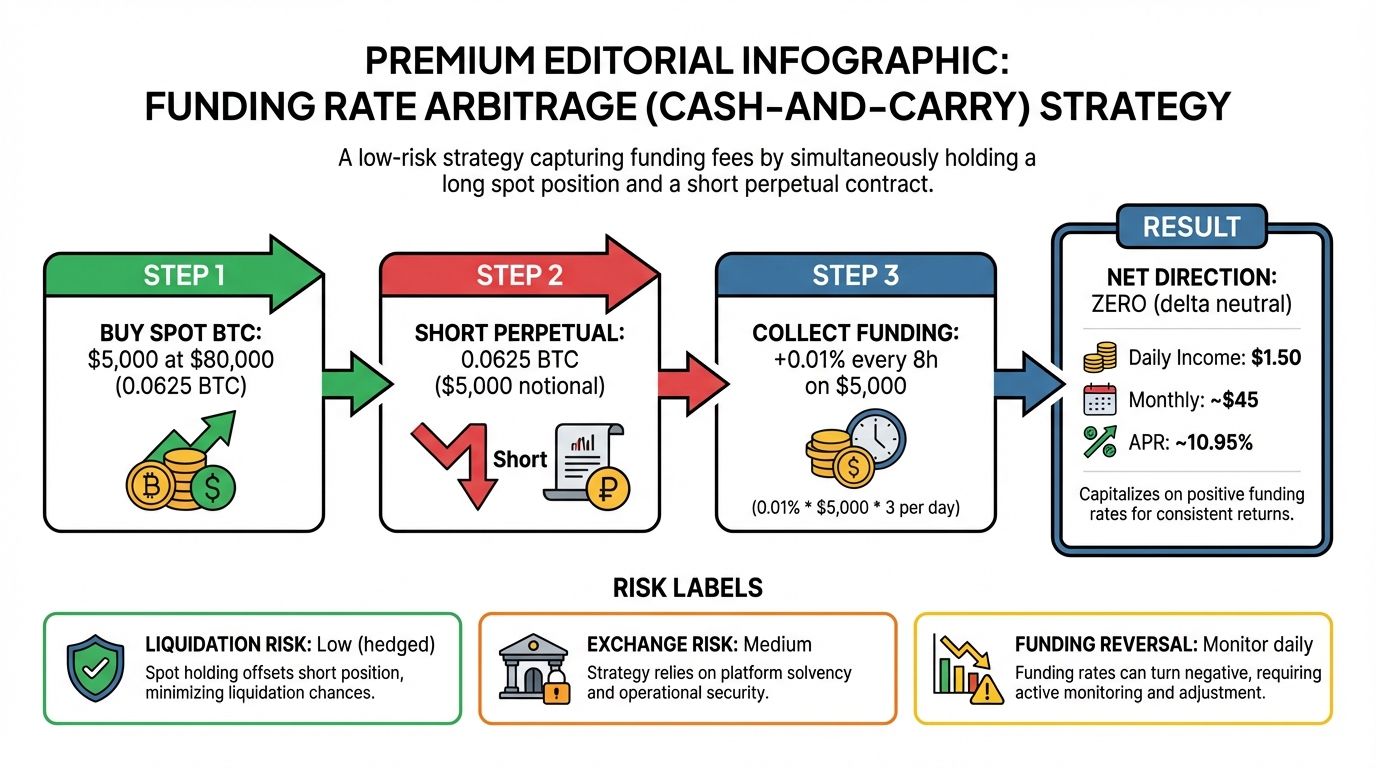
Funding rate arbitrage relies on a simple mechanical mismatch: perpetual futures prices occasionally drift away from spot prices, and the funding fee is the mechanism that pulls them back together. Traders capture this drift by holding a long spot position and a short perpetual position (or vice versa) to create a delta-neutral portfolio. The goal is to collect the periodic funding payment while the hedged positions offset each other’s price exposure.
The strategy faces a significant constraint in 2026: market efficiency. As automation and high-frequency trading firms have saturated the space, the raw spreads available to retail traders have narrowed considerably. Consistent profitability no longer comes from finding a simple price gap; it depends on execution quality, fee structures, and access to reliable infrastructure. If your trading fees exceed the funding yield, the strategy becomes a guaranteed loss.
To navigate this, you must treat the funding rate not as a guaranteed income stream, but as a variable spread that requires active management. You need to monitor the cost of borrowing against the yield. If the cost of maintaining the hedge rises above the funding payment, the trade flips from profitable to costly. This dynamic requires constant monitoring and often favors automated execution systems that can react to spread changes in milliseconds rather than minutes.
Evaluating the tradeoffs of funding rate arbitrage
Funding rate arbitrage is a delta-neutral strategy where you hold a long spot position and a short perpetual futures position, or vice versa, to collect the periodic funding payments. While the concept is straightforward—harvesting the premium paid by leveraged traders—the execution requires navigating significant infrastructure and market risks. Success in 2026 depends less on finding wide spreads and more on managing the hidden costs and technical friction inherent in cross-exchange or cross-venue trading.
The primary advantage of this approach is its theoretical independence from market direction. By hedging price exposure, you isolate the funding rate as your sole source of return. However, this neutrality is fragile. If the funding rate turns negative, your position may require payments rather than generating income. Basis risk can also erode profits if the futures price diverges significantly from the spot price for extended periods, creating unrealized losses on the hedge leg that outweigh the funding collected.
Liquidity and slippage present another major hurdle. To maintain a true hedge, you must enter both legs simultaneously. In thin markets or during high volatility, the spread between the buy and sell price can widen, eating into your margin. Additionally, exchange-specific risks such as withdrawal limits, API downtime, or changes in fee structures can disrupt the strategy. A delay in rebalancing can leave you exposed to directional risk, turning a neutral trade into a speculative bet.
To evaluate whether a specific funding arb setup is viable, compare the following factors across your target exchanges or venues. The table below highlights the key tradeoffs between centralized exchanges (CEXs) and decentralized exchanges (DEXs), which are increasingly popular for this strategy due to lower counterparty risk but higher gas costs.
| Factor | Centralized (CEX) | Decentralized (DEX) |
|---|---|---|
| Counterparty Risk | High (exchange insolvency risk) | Low (smart contract risk only) |
| Execution Speed | Fast (internal order books) | Slower (block confirmation times) |
| Fee Structure | Taker/maker fees + withdrawal fees | Gas fees + protocol fees |
| Liquidity Depth | Generally deeper for major pairs | Varies; often shallower |
| Regulatory Exposure | High (KYC/AML requirements) | Lower (permissionless access) |
When selecting a venue, prioritize reliable infrastructure over slightly higher funding rates. A strategy that cannot be rebalanced quickly due to API latency or network congestion is more likely to suffer from slippage than one with slightly higher explicit fees. Always backtest your specific pair against historical funding data to ensure the annualized return justifies the operational complexity and capital lock-up.
Choose the next step
Funding Arb Strategy works best as a clear sequence: define the constraint, compare the realistic options, test the tradeoff, and choose the path with the fewest hidden costs. That order keeps the advice usable instead of decorative. After each step, pause long enough to check whether the recommendation still fits the reader's actual situation. If it depends on perfect timing, unusual access, or a best-case budget, include a simpler fallback.

Watch Out for These Weak Funding Arbitrage Options
Funding rate arbitrage remains a viable strategy in 2026, but the landscape has shifted. Opportunities are smaller and more competitive due to automation and market efficiency. Consistent profitability now depends on execution quality, low fees, and access to reliable trading infrastructure rather than simple price gaps.
Many traders fall into traps by choosing platforms that look attractive on the surface but hide significant risks. Below are common weak options and misleading claims to avoid when setting up your delta-neutral position.
Ignoring Execution Fees
High trading fees can erase your funding income. A strategy that nets 5% annually might turn negative after accounting for exchange fees. Always calculate your break-even point by including maker and taker fees on both the spot and perpetual legs.
Overleveraging the Perpetual Leg
Using high leverage to boost returns increases liquidation risk. If the market moves against your short leg, you could lose your principal. Stick to low or no leverage to maintain the delta-neutral hedge.
Choosing Unreliable Exchanges
Not all exchanges offer the same reliability. Some may have liquidity issues or downtime during volatile periods. Research the exchange’s track record and ensure it supports the assets you need. Reliable infrastructure is more important than slightly higher funding rates.
Funding arbitrage strategy: what to check next
Funding rate arbitrage is a delta-neutral strategy that captures the premium paid by leveraged traders in perpetual futures markets. It involves taking a long position on the spot market while simultaneously shorting the perpetual contract on the same asset. Because the long and short legs offset each other, price movements have minimal impact on your portfolio, while the periodic funding payments become a steady income stream.
Does crypto arbitrage still work in 2026? The short answer is yes, but the days of easy, gap-filling profits are over. Automation and market efficiency have compressed spreads significantly. Today, profitability depends less on finding a price gap and more on execution quality, low trading fees, and access to reliable infrastructure. You are now competing against high-frequency algorithms, so your edge must come from speed or niche market access.
What is an example of an arbitrage strategy? Beyond crypto, classic arbitrage involves buying an asset on one exchange where it is cheaper and selling it on another where it is more expensive. For instance, if a stock trades at $50 on the NYSE and $50.10 on the LSE, an arb trader buys on the NYSE and sells on the LSE to capture the $0.10 difference. In funding arbitrage, the "difference" is the funding rate itself, which can be viewed as the cost of leverage.
What is an arb in financial terms? Arbitrage, or "arb," refers to the simultaneous purchase and sale of an asset to profit from a difference in price. It exploits temporary inefficiencies in markets. In the context of funding rates, the inefficiency is the persistent divergence between the perpetual contract price and the spot price, anchored by the funding mechanism.
No comments yet. Be the first to share your thoughts!