How funding rate arbitrage works
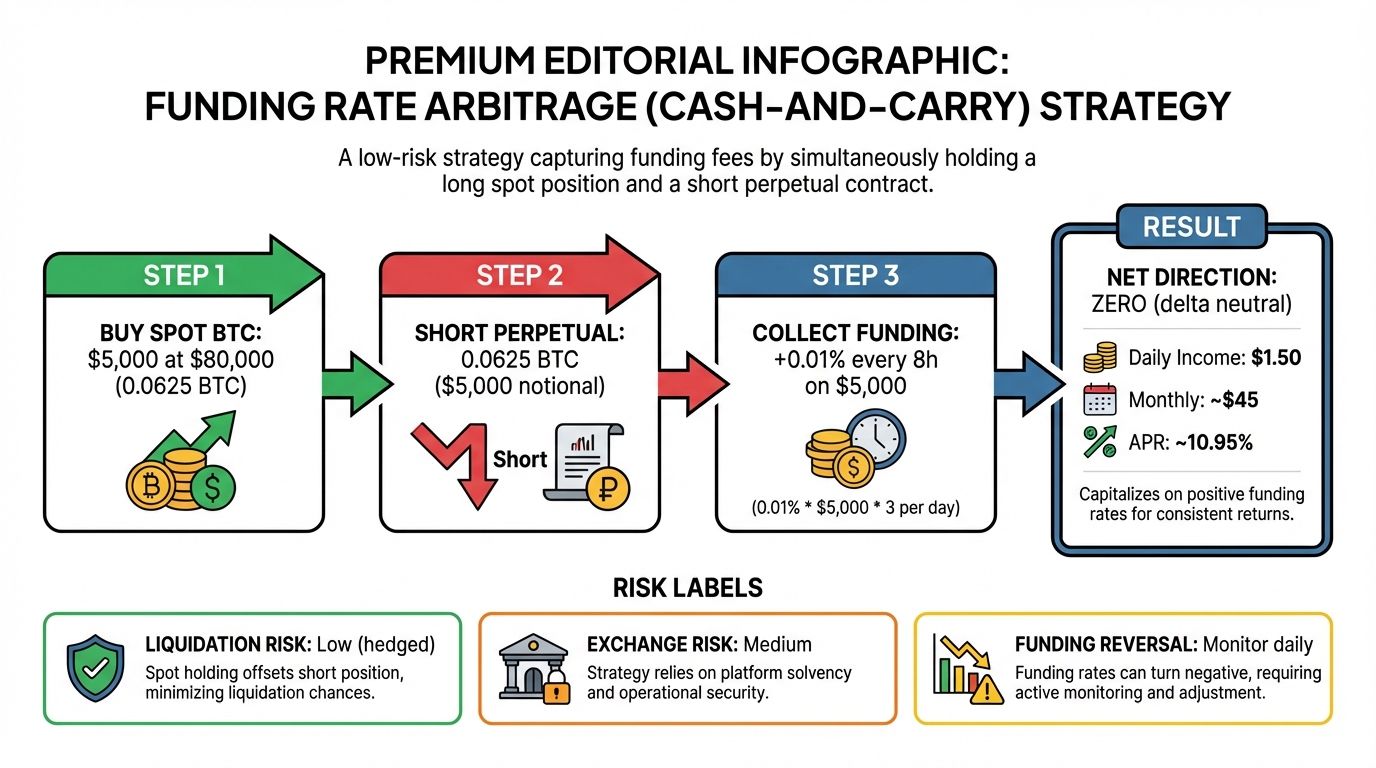
Funding rate arbitrage is a delta-neutral strategy that captures the periodic funding payment exchanged between long and short traders on perpetual swap markets [1]. The goal is simple: you hold an asset in your spot wallet while simultaneously opening an equal-sized short position in the perpetual futures market. Because your long spot exposure and short futures exposure offset each other, your portfolio's value remains stable regardless of whether the asset price goes up or down.
The profit comes from the funding mechanism itself. Perpetual swaps lack an expiration date, so exchanges use funding payments to tether the contract price to the underlying spot price. When the market is bullish, longs pay shorts; when it is bearish, shorts pay longs. By holding the short perp position, you collect these payments every eight hours (or whatever interval the exchange uses) from the leveraged traders on the other side.
This structure creates a yield-bearing position that is largely insulated from market direction. You are not betting on Bitcoin going to $100,000 or crashing to $20,000. You are betting that the funding rate will remain positive and that you can capture those payments over time. The trade is essentially a carry trade, where the "carry" is the funding fee rather than an interest rate.
To see how these rates fluctuate in real-time, look at the chart below. It shows the funding rate spread for BTC/USDT, illustrating the periodic spikes and dips that drive the arbitrage opportunity.
While the concept is straightforward, the mechanics require precision. You must ensure your spot and perp positions are perfectly balanced to maintain delta neutrality. Any imbalance exposes you to directional risk, which can wipe out the funding payments you are trying to earn. The chart above visualizes the volatility you are navigating; the funding rate is not static, and understanding its behavior is essential for a successful funding arb guide.
[1] https://www.sharpe.ai/learn/funding-rate-arbitrage
Calculating the real annualized return
The headline number on an exchange is the periodic funding rate, usually expressed as a fraction of a percent per eight-hour interval. To understand your actual yield, you need to convert that slice of time into an annual figure. The standard method is simple multiplication: take the periodic rate and multiply it by the number of intervals in a year.
Since funding events occur every eight hours, there are 3 intervals per day and 365 days in a year. This gives you 1,095 intervals annually. If a coin pays a 0.05% funding rate every interval, your gross annualized percentage rate (APR) is roughly 5.48%. This calculation is straightforward, but it misses the compounding effect that turns APR into annual percentage yield (APY).
To get the true APY, you apply the compounding formula: (1 + periodic_rate)^1095 - 1. In the example above, the APY would be slightly higher than the APR because you are reinvesting the funding payments. However, this is gross yield. It does not account for trading fees, exchange withdrawal costs, or the bid-ask spread on entry and exit. For a delta-neutral funding arb guide, these frictions are what determine whether the strategy actually pays off.
Essential infrastructure for execution
Funding arbitrage is a mechanical trade, not a speculative one. Your edge comes from the reliability of your infrastructure, not from predicting market direction. If your API connections drop or your position sizing is off by a fraction, the spread evaporates before you can react. Building a robust technical stack requires three specific layers: exchange access, programmatic connectivity, and real-time monitoring.
Exchange accounts and API access
You need accounts on at least two major centralized exchanges (CEXs) that offer both spot and perpetual futures markets. The goal is to go long on spot while shorting the corresponding futures contract. Binance, Bybit, and OKX are the most common choices due to their deep liquidity and low trading fees, which directly impact your net arbitrage return.
Once accounts are funded, generate API keys immediately. Do not trade manually for funding arb; the latency is too high. You will need API keys with "Spot Trading" and "Futures Trading" permissions enabled. Crucially, restrict these keys to IP whitelisting only. Never enable withdrawal permissions on your trading API keys. This security measure ensures that even if your monitoring server is compromised, the attacker cannot drain your capital.
Monitoring tools
You cannot watch the screen manually. You need a tool that tracks the funding rate differential in real time. Many traders use custom scripts that ping exchange APIs every few seconds, but dedicated platforms like Coinglass or Bybit’s native funding rate page provide a reliable baseline. Look for tools that visualize the spread between the spot price and the futures price, as this is your actual margin of safety.
The infrastructure isn't just about data; it's about execution speed. A slow monitoring tool means you miss the entry window. Ensure your chosen monitoring solution offers alerting capabilities so you can react when spreads widen unexpectedly. Without this layer, you are flying blind, and in funding arb, blindness is expensive.
Market context
Understanding the current market environment is essential for setting your risk parameters. Funding rates fluctuate based on market sentiment, and your infrastructure must handle these shifts. Below is the current price action for Bitcoin, the primary asset used in most funding arb strategies.
Managing Risk in Basis Trades
Basis trades are often described as "low risk" because the profit is theoretically locked in the spread between spot and futures prices. However, this label is misleading. The strategy is capital-intensive and leverages thin margins, meaning small execution errors or market shocks can wipe out weeks of funding rate accumulation. When you are trading with borrowed capital, the margin for error shrinks to zero.
The most immediate threat is liquidation risk. Even if the basis converges correctly, a sudden spike in the underlying asset's price can trigger margin calls on your long spot position before the funding payments compensate for the loss. This is why maintaining a healthy buffer above the maintenance margin requirement is not optional—it is the primary defense against forced liquidation. A sudden 5% move in Bitcoin, for example, can liquidate an undercapitalized position instantly, leaving you with a negative basis trade that bleeds money every 8 hours.
Exchange counterparty risk is the second major vulnerability. Funding arbitrage requires holding assets on two different venues: spot on one exchange and perpetual futures on another. If either exchange experiences a technical outage, halts withdrawals, or faces solvency issues, your strategy freezes. You cannot close the position to realize profits or cut losses. The collapse of FTX in 2022 demonstrated that even large, seemingly stable exchanges can fail, locking up user funds indefinitely. Always segregate your arb capital from your primary trading balance and monitor exchange health metrics daily.
Finally, basis convergence risk is structural but unpredictable. The spread between spot and futures prices does not always converge smoothly. During periods of extreme market stress or regulatory news, the basis can widen significantly, requiring more margin to maintain your positions. This is why robust risk management in funding arbitrage is less about predicting price direction and more about ensuring you have the liquidity and infrastructure to survive volatility.
Tools and Platforms for Funding Arb
Running a funding rate arbitrage strategy requires reliable infrastructure to track rates, execute trades, and manage risk. The right tools separate profitable operations from manual errors. Below are the essential components of a funding arb stack.
Funding Rate Scanners
Real-time data is non-negotiable. You need scanners that update frequently across multiple exchanges. ArbitrageScanner.io and CryptoArbitrage.net offer dedicated funding rate trackers. Look for tools that support at least five major exchanges, provide historical data for backtesting, and offer API access for automation. Free tiers often have significant delays; paid plans are usually necessary for live trading.
Trading Bots
Automation reduces latency and emotional decision-making. Platforms like 3Commas and Cryptohopper allow you to set up grid trading bots or custom scripts that trigger positions when funding rates exceed your threshold. Ensure the bot supports cross-margin futures and spot pairs, as this is core to the delta-neutral structure. Always test strategies on testnets before deploying capital.
Exchanges
Liquidity and low fees are critical. Binance, Bybit, and OKX are the primary venues for funding rate arbitrage due to their high volume and tight spreads. Compare their maker/taker fees, as high trading costs can erase small funding rate profits. Ensure the exchange supports the specific perpetual contracts you intend to trade and has robust security measures.

Comparison of Key Tools
| Tool Type | Examples | Key Feature | Cost |
|---|---|---|---|
| Scanner | ArbitrageScanner.io | Multi-exchange real-time data | Freemium |
| Bot | 3Commas | Custom strategy scripts | Monthly subscription |
| Exchange | Binance | High liquidity, low fees | Tiered fees |
Essential Infrastructure
Beyond software, you need hardware wallets for secure storage of your spot holdings. Ledger and Trezor devices are standard for cold storage. Additionally, consider investing in books on quantitative trading and risk management to deepen your understanding of delta-neutral strategies.



As an Amazon Associate, we may earn from qualifying purchases.
Pre-flight checklist for new traders
Funding Arb works best as a clear sequence: define the constraint, compare the realistic options, test the tradeoff, and choose the path with the fewest hidden costs. That order keeps the advice usable instead of decorative. After each step, pause long enough to check whether the recommendation still fits the reader's actual situation. If it depends on perfect timing, unusual access, or a best-case budget, include a simpler fallback.
No comments yet. Be the first to share your thoughts!