How funding rate arbitrage works
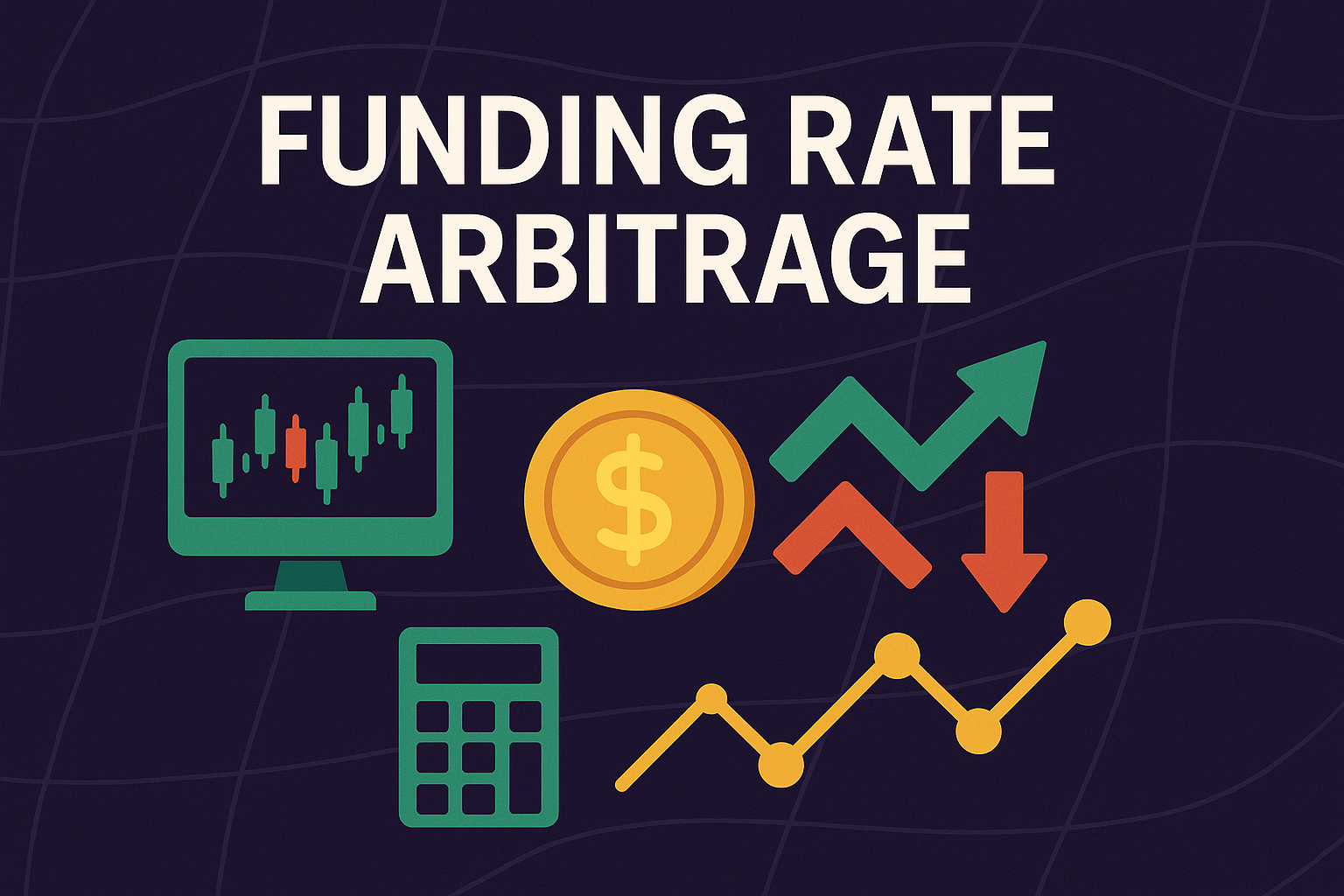
Funding rate arbitrage is a straightforward concept: borrow capital at a low interest rate, then invest that money where it generates higher returns. In crypto, this mechanism allows traders to profit from the periodic payments exchanged between long and short positions, rather than betting on the asset’s price direction.
The core mechanism involves combining long positions with low funding rates on one exchange with short positions on another exchange with higher funding rates. By holding a long position on Exchange A and a short position on Exchange B, you create a delta-neutral portfolio. If Exchange B’s funding rate is positive and higher than Exchange A’s, you receive payments from shorts on B while paying minimal fees to longs on A, capturing the spread.
At its core, arbitrage is a low-risk strategy to earn a short-term profit. Traders are not wagering on the asset's price moving in a specific direction. Instead, they are simply betting that they can realize a profit when the funding rate differential remains favorable. This approach provides stable income, though it carries risks in extreme market conditions where price spikes can trigger liquidation on one side of the position.
The 2026 Funding Arb Landscape
The infrastructure supporting funding rate arbitrage has shifted dramatically in 2026. What was once a simple exercise in cross-exchange price comparison has evolved into a complex dance between centralized exchanges (CEXs) and decentralized perpetual DEXs. The rise of platforms like Hyperliquid has altered the traditional arb landscape, creating new opportunities and risks that didn't exist just a few years ago.
Hyperliquid and similar perpetual DEXs operate on different funding mechanisms than traditional CEXs. While CEXs typically use a 8-hour funding interval based on the premium of the perpetual contract over the spot price, DEXs often employ continuous or shorter-interval funding rates. This structural difference means that the "classic" funding arb strategy—going long on one exchange and short on another—no longer guarantees profit. The spread between CEX and DEX funding rates can be volatile, and sometimes negative, making the arb unprofitable if not carefully structured.
This divergence requires traders to monitor multiple data sources simultaneously. Real-time tracking of funding rates across CEXs and DEXs is no longer optional; it's essential. Tools like Coinglass and Amberdata provide the necessary visibility, but the sheer volume of data can be overwhelming. The key is to identify persistent divergences rather than chasing short-lived spikes.
Another critical shift is the increase in liquidity fragmentation. In 2026, top assets like Bitcoin and Ethereum are traded across dozens of venues, each with its own funding rate. This fragmentation creates more arb opportunities but also increases execution risk. Slippage, latency, and counterparty risk on smaller DEXs can erode profits that look attractive on paper. Traders must now factor in not just the funding rate differential, but also the cost of moving capital between exchanges and the risk of smart contract exploits on DEXs.
The result is a more sophisticated funding arb environment. Success in 2026 requires not just understanding the mechanics of funding rates, but also navigating the complex infrastructure that supports them. Traders who adapt to these changes will find new opportunities; those who rely on outdated strategies may find their edges disappearing.
Execution strategies for funding arb
Cross-exchange funding rate arbitrage relies on capturing the spread between perpetual swap markets. The core mechanic is simple: go long on the spot asset and short the perpetual contract on an exchange where funding rates are positive. You collect the periodic funding payments while your delta-neutral position hedges against directional price moves.
Classic cross-exchange arb
This is the foundational strategy. You buy the underlying asset on Exchange A and simultaneously short the perpetual contract on Exchange B. If Exchange B has a positive funding rate, you receive payments every eight hours. The profit comes from the funding rate differential minus trading fees and withdrawal costs. This method works best when there is a clear divergence in sentiment between two major exchanges.
Cash-and-carry variants
A cash-and-carry strategy involves buying the spot asset and shorting the futures contract. While similar to cross-exchange arb, this often happens within a single exchange ecosystem or between spot and dated futures. The goal is to capture the premium of the futures contract over the spot price as it converges at expiry. This variant is often more capital-intensive due to the need to hold the physical asset.
Risk and complexity comparison
The table below outlines the trade-offs between these primary execution methods.
| Strategy | Primary Risk | Complexity |
|---|---|---|
| Cross-Exchange | Exchange counterparty & withdrawal delays | Medium |
| Cash-and-Carry | Futures basis risk & liquidation | Low |
Essential tools and data sources
Funding arb relies on speed and accuracy. You need infrastructure that tracks rates across exchanges in real time, not aggregated data that lags by minutes. A delay of even a few seconds can turn a profitable spread into a loss.
Real-time scanners and APIs
Specialized scanners aggregate funding rates from major venues like Binance, Bybit, and OKX. They filter for positive rates and calculate net yields after fees. For manual execution, direct API access to these exchanges is standard. Developers use these endpoints to build bots that execute trades when spreads widen beyond a set threshold.
Connect to exchange APIs or subscribe to a funding rate scanner. Ensure the data feed updates every 8 hours or less to catch rate resets.
Watch for discrepancies between the spot price and perpetual futures price. Look for rates that exceed your cost of capital and trading fees.
Open a long position on the spot market and a short position on the futures market simultaneously. This neutralizes directional price risk.
Hardware and connectivity
Reliable execution requires more than just software. High-speed internet reduces latency, ensuring your orders fill before the rate resets. Multiple monitors allow you to watch different exchanges and order books simultaneously. For those building custom bots, a VPS located near exchange servers can shave off critical milliseconds.


As an Amazon Associate, we may earn from qualifying purchases.
Data verification
Always cross-reference scanner data with official exchange pages. Some third-party tools may display outdated rates or exclude smaller venues. Use CoinGlass or Amberdata for broader market context, but verify the specific rate on the exchange where you intend to trade.
Managing liquidation and basis risk
Funding arbitrage is often marketed as a "market-neutral" strategy, but that label hides the mechanical risks inherent in holding leveraged positions across different venues. While the goal is to capture the spread between funding rates, you are simultaneously exposed to liquidation events and the risk that the basis converges before you can exit. In a high-stakes environment, these risks can turn a theoretically profitable trade into a total loss.
Liquidation risk is the most immediate threat. Because you are typically long one exchange and short another to remain delta-neutral, a sharp price move in either direction can trigger a margin call on one side of your trade. If the exchange you are short on experiences a rapid spike, you may be forced to liquidate at a loss, even if the funding rate spread remains favorable. This is why strict risk management and adequate collateral buffers are non-negotiable.
Basis convergence risk is more subtle but equally dangerous. The profit from funding arb relies on the spread between the perpetual contract price and the spot price remaining stable or widening. If the market conditions change and the basis converges too quickly, you may be left holding positions that no longer generate the expected income, or worse, you may be forced to close them at a loss to avoid further exposure.
Exchange solvency and counterparty risk add another layer of complexity. Unlike traditional finance, crypto exchanges can fail or freeze withdrawals during periods of extreme volatility. Diversifying your capital across multiple reputable platforms can mitigate this risk, but it also increases operational complexity. You must constantly monitor the health of each exchange and have a plan for rapid withdrawal if needed.
To manage these risks, successful traders use a combination of technical tools and disciplined execution. This includes setting tight stop-losses, monitoring funding rates in real-time, and maintaining a diversified portfolio of positions across different exchanges and assets. The goal is not to eliminate risk entirely, but to manage it in a way that preserves capital and allows for consistent returns over time.
Funding arbitrage guide: frequently asked: what to check next
Funding arbitrage relies on capturing the difference between spot and perpetual futures prices. While the mechanics are straightforward, execution requires precision to manage counterparty and liquidation risks. Below are the most common questions from traders navigating the 2026 landscape.
No comments yet. Be the first to share your thoughts!