What funding rate arbitrage actually is
A funding arb strategy uses perpetual futures contracts to generate yield from periodic payments, rather than betting on price direction. Perpetual contracts are designed to stay anchored to the spot market price through these payments. When the market is bullish, long traders pay short traders. When it’s bearish, the flow reverses. The funding rate arbitrage strategy exploits these payments by holding equal long and short positions, effectively neutralizing exposure to the underlying asset's price movements.
The mechanism works by capturing the spread between the spot price and the perpetual contract price. If you buy an asset on the spot market and simultaneously short the same asset on a perpetual futures exchange, you are market-neutral. Your profit or loss no longer depends on whether Bitcoin or Ethereum goes up or down. Instead, your return is driven entirely by the funding rate. As long as the rate remains positive, your short position collects payments from the long positions, creating a steady income stream.
This approach transforms volatility from a risk into a revenue source. In a standard spot trade, a 10% drop in price wipes out your gains. In a funding arb setup, that same 10% drop increases the value of your short position by exactly what it decreases the value of your spot holding. The net effect is zero price impact. The only variable that matters is the funding interval. By collecting these payments, often every eight hours, you build returns that compound independently of market sentiment.
The chart above visualizes the funding rate for BTC perpetuals. While the spot price of Bitcoin fluctuates wildly, the funding rate represents the cost of maintaining that leverage. A positive rate indicates that longs are paying shorts, which is the ideal environment for a funding arb strategy. Traders monitor these rates to identify when the cost of leverage is high enough to make the arbitrage profitable after accounting for trading fees and spread costs.
How the spot-perp funding arb strategy works
The spot-perp funding arbitrage strategy is a market-neutral approach that lets you capture yield from crypto funding rates without betting on price direction. It relies on a simple setup: you buy the asset on the spot market and simultaneously short the same amount on the perpetual futures market on the same exchange. Because your long and short positions are equal in size, price movements cancel each other out, leaving the funding rate as your primary source of profit or loss. This cash-and-carry structure effectively locks in the funding payment as your return.
To execute this, you purchase the underlying asset, such as 1 BTC, in your spot wallet. Immediately after, you open a 1 BTC short position on the perpetual contract. When the funding interval hits, the exchange checks the market balance. If the perpetual price is higher than the spot price (contango), longs pay shorts. Since you are the short side, you receive the payment. If the rate is negative, you pay it. The goal is to find exchanges where the rate is consistently positive, allowing you to collect these payments regularly while your principal exposure remains hedged.
This strategy is often described as collecting "rent" on your crypto holdings. Just as a landlord earns income from a tenant occupying a property, you earn income from traders who are levered long and willing to pay a premium to maintain their positions. The profit isn't tied to whether Bitcoin goes up or down, but rather on the willingness of leveraged traders to pay for that leverage. By neutralizing price risk, you isolate the funding rate as your net profit and loss driver.
Cross-exchange spread trading
Cross-exchange spread trading takes the funding arb strategy to the next level by exploiting rate discrepancies between different venues. Instead of relying on a single exchange's funding rate, traders simultaneously buy spot and short perp on one platform while holding the opposite positions on another. This approach isolates the spread between the two exchanges' funding rates, effectively capturing yield from market inefficiencies rather than just directional sentiment.
The mechanics are straightforward but require precise execution. If Exchange A is paying 0.1% funding while Exchange B is paying 0.05%, you might short on Exchange A and hold a long spot position on Exchange B. The goal is to pocket the 0.05% difference every eight hours, regardless of where Bitcoin's price is heading. This method transforms funding payments from a single-source income stream into a diversified arbitrage play.
However, this strategy introduces operational complexity. You must manage liquidity across two platforms, ensuring that withdrawal limits or network congestion don't delay rebalancing. Slippage on entry and exit can quickly erode thin spreads, making this approach viable primarily for high-volume traders with established accounts on major exchanges like Binance and Bybit.
To help visualize the tradeoffs, here is how cross-exchange spreads compare to single-exchange strategies on key metrics.
| Metric | Single-Exchange | Cross-Exchange |
|---|---|---|
| Complexity | Low | High |
| Capital Efficiency | Moderate | High |
| Counterparty Risk | Single platform | Dual platform |
| Spread Potential | Market average | Arbitrage premium |
Infrastructure and real-time tools
A funding arb strategy relies entirely on speed and data accuracy. The spread between spot and perpetual funding rates is rarely static; it fluctuates with market volatility and liquidity shifts. If you are manually checking rates, you are likely too late. The window to enter a position before the spread narrows or reverses can be measured in seconds, not minutes.
Automated infrastructure is non-negotiable for this approach. You need a system that monitors multiple exchanges simultaneously, calculating the real-time arbitrage opportunity after accounting for trading fees and withdrawal costs. Manual execution introduces latency that quickly erodes profits, especially in high-frequency funding environments. Reliable API connections are essential to ensure your orders fill at the intended price before the market adjusts.
Beyond execution, you must monitor your positions continuously. Exchange risk, such as withdrawal suspensions or sudden changes in margin requirements, can trap your capital. Automated alerts for these events allow you to react before conditions deteriorate. For a detailed breakdown of how these strategies perform under different market conditions, see the Presto Labs research on optimizing funding fee arbitrage, which highlights the importance of risk-adjusted returns in automated systems.
While manual trading might seem sufficient for small accounts, scaling a funding arb strategy requires robust technical infrastructure. Without it, you are competing against bots designed to capture these exact inefficiencies. The tools you choose will determine whether you capture the spread or merely watch it disappear.
Execution checklist for traders
A funding arb strategy relies on collecting positive funding rates while hedging directional exposure. To execute this effectively, you need a disciplined workflow that prioritizes risk management over yield chasing. The goal is to isolate the funding payment as your primary source of profit.

Scan the market for assets with consistently positive funding rates. Look for rates that are sustainable rather than spikes caused by extreme short squeezes. A steady positive rate indicates a healthy bullish sentiment in the perpetual market, which is ideal for your long spot and short perp setup.
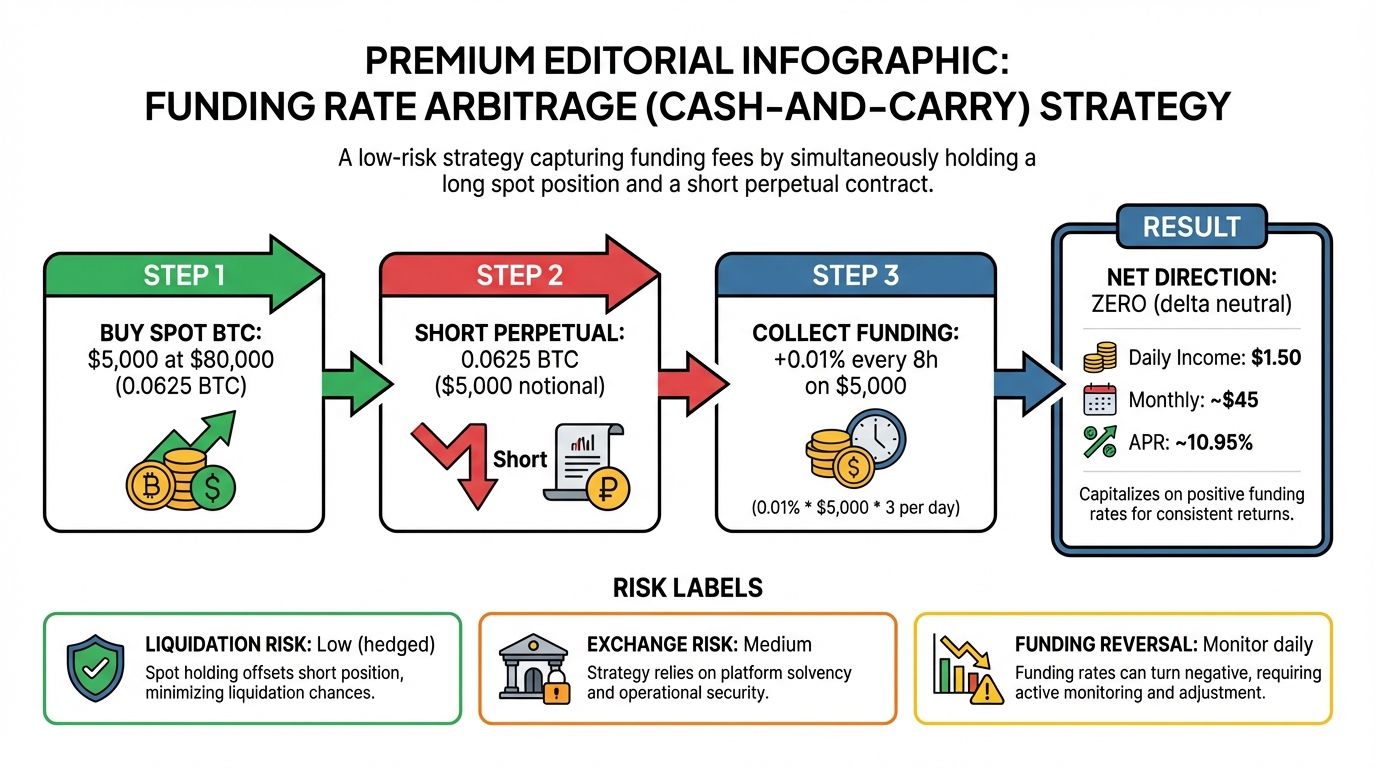
Before entering the trade, run the numbers. Multiply the periodic funding rate by the number of payments in a year to get the annualized yield. Ensure this yield comfortably exceeds your trading fees, exchange spreads, and any potential funding rate volatility. If the margin is too thin, the trade is not worth the operational risk.
Simultaneously buy the asset on the spot market and short the same amount on the perpetual market. This creates a delta-neutral position. By holding equal and opposite positions, price movements cancel each other out, leaving you exposed only to the funding rate payments.

Even with a hedge, your short perp position has liquidation risk. Monitor your margin ratio closely. If the market moves sharply against your short, you may need to add collateral or adjust your position to avoid liquidation, which would turn a risk-free arb into a directional loss.
Decide on your exit strategy in advance. You can hold indefinitely as long as funding remains positive, or close the position if the rate turns negative or if you need to realize profits. Always factor in withdrawal fees and the time cost of moving capital between exchanges if you are using cross-exchange spreads.
This workflow transforms the funding rate from a market metric into a predictable income stream. By following these steps, you can execute a funding arb strategy with greater confidence and fewer operational hiccups.
Is the funding arb strategy actually profitable?
The short answer is yes, but it is not a free lunch. A recent study published in ScienceDirect by W. Werapun (2025) provides concrete evidence that a well-executed funding arb strategy can generate substantial returns. The research highlights a specific Drift XRP strategy that achieved a 115.9% return over six months.
What makes this data particularly compelling for risk-averse traders is the drawdown profile. Despite the high returns, the maximum drawdown was limited to just 1.92%. This was accomplished using 7x leverage, demonstrating that funding rate arbitrage can offer a favorable risk-adjusted return compared to directional crypto trading. The strategy works by collecting funding payments from the perpetual futures market while holding an offsetting spot position, effectively neutralizing directional price risk.
Helpful gear
Use these product recommendations as a starting point, then choose the size, material, and price point that fit how you actually use the gear.



As an Amazon Associate, we may earn from qualifying purchases.
No comments yet. Be the first to share your thoughts!