The Hidden Costs of Funding Rate Arbitrage
Funding rate arbitrage sounds like risk-free yield, but the mechanics of execution introduce real constraints. The strategy relies on a spread between two markets, typically a perpetual futures contract and a spot position. In theory, you hold both sides to capture the periodic funding payments. In practice, the spread is rarely wide enough to cover all friction points.
Slippage and fees are the first major hurdle. Entering and exiting positions on two different exchanges simultaneously means paying trading fees twice. If the funding rate is 0.01% every eight hours, the annualized return looks attractive. However, a 0.1% fee on entry and exit wipes out days of potential profit. High-frequency adjustments to maintain the hedge can quickly turn a profitable trade into a net loss.
Liquidity constraints further limit scalability. Large capital bases struggle to find sufficient depth on both the long and short legs of the trade without moving the market against themselves. When liquidity dries up during volatile periods, the cost to rebalance the hedge spikes. This often forces traders to widen their stop-losses or reduce position sizes, directly impacting yield.
Counterparty and platform risk add another layer of complexity. The strategy assumes both exchanges will honor their funding calculations and allow withdrawals. Exchange outages, withdrawal delays, or changes to funding rate algorithms can trap capital or erase profits overnight. Regulatory shifts in one jurisdiction can also impact the availability of the necessary instruments, making the "arbitrage" impossible to execute.
Finally, the opportunity window is narrowing. As more capital enters the space, the spreads between funding rates compress. What was once a reliable 5-10% annual yield may shrink to 2-3% or even turn negative. Traders must constantly monitor the spread and be ready to exit when the risk-reward ratio no longer justifies the operational overhead. The edge is real, but it is thin and fleeting.
Funding arb choices that change the plan
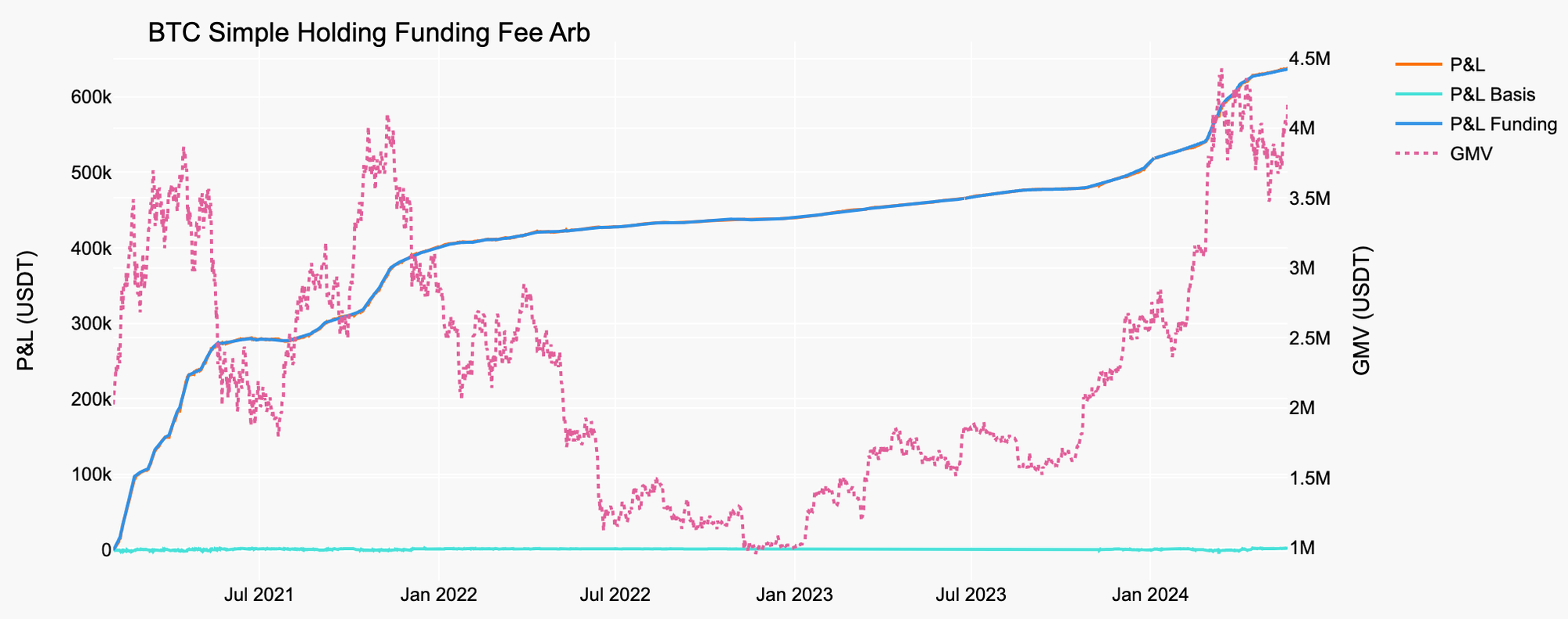
Funding rate arbitrage is not a passive income stream; it is a trade-off between yield and risk exposure. The strategy relies on the basis between spot and perpetual futures prices, meaning your profit is derived from the difference in funding rates, not from price appreciation.
To evaluate whether a specific trade is worth the capital deployment, you must weigh four concrete factors: the cost of borrowing, the volatility of the basis, the liquidity of the exit, and the operational complexity across exchanges.
Basis Volatility and Mean Reversion
The spread between spot and futures prices is not static. It fluctuates based on market sentiment, with long-dominant markets paying positive funding and short-dominant markets paying negative. If the basis narrows faster than the funding payments accumulate, you may face a loss on the hedged position even if the funding rate remains positive. This risk is highest during periods of high volatility, such as major macroeconomic announcements or exchange-specific outages.
Exchange Counterparty and Operational Risk
Cross-exchange arbitrage requires holding assets on two different platforms. This introduces counterparty risk: if one exchange halts withdrawals or experiences a technical failure, your hedge becomes ineffective. Also, transfer times can vary significantly. A slow deposit or withdrawal can cause you to miss a funding settlement window, eroding your expected yield. Always verify withdrawal limits and processing times before allocating capital.
Slippage and Liquidity Depth
Entering and exiting large positions can move the market against you. If the order book lacks depth, your trade execution price may be worse than the quoted mid-price, directly reducing your net yield. This is particularly relevant for lower-cap altcoins, where spreads are wider and liquidity is thinner. For major assets like Bitcoin, slippage is minimal, but for smaller tokens, it can turn a theoretical 10% annualized yield into a net loss.
Capital Efficiency and Leverage Costs
While leverage can amplify your returns, it also amplifies your costs. Borrowing fees on the leveraged side of the trade can eat into the funding payment you receive. Additionally, higher leverage increases the risk of liquidation if the underlying asset moves sharply against your spot position. A 1x hedge is nearly risk-free from liquidation but offers low yield; a 3x hedge offers higher yield but requires tighter risk management and more frequent rebalancing.
Build a Funding Arbitrage Decision Framework
Funding rate arbitrage is no longer a simple "buy spot, sell futures" play. With 2026’s new infrastructure—perpetuals on Hyperliquid, on-chain margin on Solana, and cross-chain bridges—execution complexity has risen. A structured decision framework filters out noise and highlights where the yield actually lives.
Use this checklist to evaluate opportunities. If an opportunity fails more than one check, skip it. The goal is consistency, not chasing the highest single-day rate.
Look for a spread greater than 0.05% per 8-hour interval. Rates below this threshold rarely cover trading fees and slippage. Compare the long-side rate on one exchange against the short-side rate on another. If the spread is thin, the market is efficient; move on.
Subtract trading fees (maker/taker), withdrawal fees, and bridge costs from your projected yield. Include the cost of capital if you are borrowing. A 0.08% rate sounds good until you realize bridge withdrawals cost 0.05%. Net yield must remain positive after every friction point.
Check the maintenance margin requirements for your short position. If the asset is volatile, a small price move against your short can trigger liquidation, wiping out weeks of funding gains. Prefer assets with deep liquidity and lower volatility for the short leg.
Funding rates settle at specific intervals (every 8 hours on Binance, every hour on Hyperliquid). Ensure your bridge or transfer speed can keep up. If you are relying on cross-exchange transfers to rebalance, latency is your enemy. Use existing balances on both sides whenever possible.


As an Amazon Associate, we may earn from qualifying purchases.
Avoid the weak options
The easiest mistake with Funding Arb is comparing options on the most visible detail while ignoring the day-to-day constraint. A choice can look strong on paper and still fail because it is too hard to maintain, too expensive to repeat, or awkward in the actual setting. Use the same checklist for every option: fit, cost, durability, timing, upkeep, and fallback plan. That keeps the comparison practical instead of drifting into preference alone.
The simplest way to use this section is to write down the real constraint first, compare each option against it, and choose the path that still works outside ideal conditions.
No comments yet. Be the first to share your thoughts!